

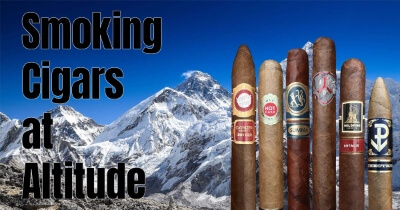
Whether atop mountain peaks or in the serenity of an elevated retreat, smoking cigars at altitude is a unique experience that demands an understanding of the nuanced interactions between altitude, air pressure, and the ceremony of cigars.
Many an enthusiast has found themselves taking a cigar that they enjoy in their hometown to the slopes, only to find themselves disappointed in the experience. Below, we’ll detail why cigars combust, draw, and taste differently at altitude than at sea level.
Altitude's Impact
Altitude, defined by the elevation above sea level, introduces a set of variables that can influence the entire cigar process. As one ascends the air pressure decreases, leading to lower oxygen levels (although the composition of gases remains the same) and altered combustion dynamics.
This is because there are less gases overall at altitude. And with less air pressure, oxygen molecules are further apart. These factors, in turn, impact the way a cigar burns, the flavors it releases, and the overall satisfaction derived from the smoking experience.
Lighting at Altitude
Every cigar journey begins with the ritual of lighting a cigar. At higher altitudes, the lower air pressure can affect the intensity of the flame, demanding a more deliberate and patient approach. Enthusiasts find themselves toasting the foot of the cigar longer than usual, ensuring an even and thorough ignition in the face of altered atmospheric conditions.
Click the image above to read that article
Smoking in the Thin Air
Cigars at altitude require a measured pace. The diminished oxygen levels can slow down the burn rate, necessitating a slower, more deliberate smoking rhythm. Simultaneously, you may find yourself doing the opposite with a tighter draw - puffing more often trying to keep it alive.
Engaging in the art of cigar smoking at higher elevations becomes an exercise in patience. The key is to realize that enjoying a cigar at altitude is a challenge and adjusting your pace (as well as mindset) to accommodate.
Enjoying a cigar at altitude will reward you for your patience, however, whenever you set your cigar down. It’s common to be able to walk away from your cigar for several minutes and come back to it smoldering in the cigar rest and ready to be picked up again.
Altitude and Flavor
It’s common to hear that cigars taste awful at altitude, but I’ve often pushed back on this notion. Personally, I’ve found that full-bodied, full-throttled blends don’t perform as well in this environment. Instead, I gravitate towards medium-bodied blends when smoking at higher elevations. The slower combustion rate is an interesting challenge, however, and I’d encourage you to experiment and see what you enjoy the most.
But at the same time, I had several friends that preferred full-bodied cigars are higher altitudes because they remarked that cigars taste less with less air. Their points are valid because our sense of smell is diminished the further we ascend above sea level. Your mileage may vary and you may prefer something different, but one thing is for certain: cigars taste very different at different elevations.
Humidity Challenges
Altitude can impact humidity levels, and enthusiasts must be vigilant in maintaining ideal conditions for their cigars. The use of a well-calibrated hygrometer, coupled with careful monitoring, ensures that cigars remain at their optimal RH for an enjoyable smoke.
Click the image above to read that article
I will always suggest plastic humidors for altitude or desert environments because it takes the guess work out of the equation. No seasoning, no active humidification devices, no headaches.
Since outdoors humidity is often lower at altitude, I preferred to keep my humidity levels in my humidors between 63-65%. This was enough to prevent the oils from evaporating, yet not too much that I had issues smoking them in very dry air.
Temperature Variations
Elevated locations often bring temperature variations as well. Extreme temperature changes can affect the burn rate, draw, and flavors of a cigar. There’s a lot that goes into this like how much you can and will taste in colder environments, but the main takeaway is to embrace the challenge.
If you notice that your cigars are cracking in colder environments, you can slow down your smoking pace and dry box them beforehand to reduce the expansion of the filler leaves. What will usually happen is that moisture and heat will cause the filler tobacco to expand and burst through the wrapper leaf. Or adjust your humidity levels to 63-65% as mentioned above.
Wind, Airflow, and Uneven Burns
Wind patterns at higher altitudes can be unpredictable, wreaking havoc on the even burn of a cigar. If possible, position yourself in a sheltered area to minimize the impact of strong winds for a more consistent, enjoyable experience.
When you are unable to position yourself against a wind block, keep your torch ready to correct any runs before they become a nuisance. You might also find success in rotating your cigar in-hand so that whichever way the wind is blowing hits a different side of your cigar from time to time.
Click the image above to read that article
Last Thoughts
Enjoying cigars at altitude is certainly a challenge. Reduced oxygen levels, altered combustion dynamics, a difference in how we perceive flavor, powerful winds, and fluctuating humidity levels are just a few of the issues you will face. My only experience is around 5000 ft of elevation, so I’m sure those that regularly spend time in 8000 ft of elevation will have seen a lot worse.
Food even tastes different at altitude: the perception of sweet and salty sensations change, carbonated drinks are fizzier, and the boiling point of water decreases the higher you go above sea level. It really is an interesting phenomenon that I’d encourage everyone to meet with an open mind.
If you live in higher elevations or have experimented with cigars at altitude, please don’t hesitate to drop a comment below and add to the conversation!


Leave your comment