

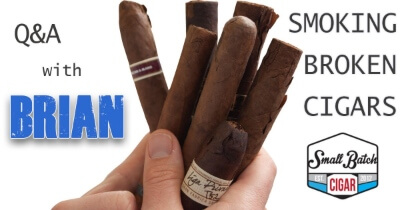
A little while back, I learned that Small Batch HQ had a resident Damaged Cigar Smoker. Given the sheer amount of sticks that come through our hub of cigar smoking excellence, I always knew that there had to be a large number of sad, broken cigars waited to be loved like a stop-motion animated movie. But I didn't expect that there was a warrior among us that took up the call to dutifully give these cigars the flame they deserve.
When I heard that Brian was our Hero, I knew we had to ask a few questions for the good of all misfit cigars and heroic men and women everywhere. Thanks Brian!
What are some of the common ways that cigars get damaged?
In my experience, cigars are easiest to damage when they (a) are out of their cello and (b) are subject to a lot of movement. The more the cigar is allowed to move and potentially hit other cigars, or the sides of the box they're contained in, or really anything solid, they're likely to at least crack in the wrapper somewhere.
I've noticed the two most likely spots to crack are in the foot and above the band. Another way I've seen cigars damaged is when you initially cut the cap on the cigar. If the cigar is dry, or the cut is too deep, or the blade isn't as sharp as it once was, the cap might crack. In my opinion, cap damage is the worst damage a cigar can have (outside of total destruction or loss of a cigar to mold, but those are the extremes).
I've had cracks in the cap turn into the complete loss of the wrapper leaf above the band multiple times. The best way I've found to help hold a cigar together with cap damage (without the use of cigar glue) is to wet the leaf lightly, either with your tongue or a small drop of water on your finger, then to try and close the crack like an envelope.
What tools do you use to repair the cigar and/or protect your smoking experience?
I don't really have any tools that I've used to repair cigars, most of the time I don't have too much time to try and fix whatever I'm smoking.
There are two ways I've seen to use a tool of some sort to help improve smoking a broken cigar. If someone happens to dabble in pipe smoking, you can literally "stick it in your pipe and smoke it". I'd imagine this only works when the cigars ring gauge matches the bowl size on the pipe, if there's too much room on the sides the draw would be affected.
As a last ditch effort on a cigar I don’t care about, I’ve used the poker tool on my scissors to pierce the cigar and hold the wrapper together. This is very delicate and isn't 100% effective, but if you get the wrapper leaf at the right point, it should hold together.
I've had the second method work in the past but I’m not comfortable recommending it as a regular fix. Too much could go wrong, as I'm continuing to discover. Instead, I think the best course of action is to either hold it with the fingers you use to hold your cigar, or to remove the broken bits of the wrapper leaf from the cap. The latter is rough because smoking with the binder in your mouth is pretty gnarly, but in all honesty it’s not worth the effort trying to keep the leaf on most of the time.
When is a cigar absolutely unable to be smoked?
I think the point of "unsmokable" will be different for many people, but for me, when the cigar is going to cause more problems than it's worth, I won't bother to smoke it. This point, in my case, is when the wrapper leaf is extremely damaged, especially around the cap. If the tobacco around the cap is loose, or I'm constantly having to remove loose tobacco from my mouth, then I'll toss the cigar.
Other than that, I find that most damage to the foot and body of a cigar is manageable. I should note that I am not a picky smoker in the slightest, mostly because what I smoke at work will likely sit for a while, I'll relight it many times, etc. Some of the things I'll be fine with would be deal-breakers for others.
My rule of thumb is if the work you need to put into a cigar to repair it takes away from your enjoyment of the cigar, it's not worth smoking. I would only go to great lengths to save a cigar I couldn't get anymore, or if it was special to me in some way.

What’s the worst cigar that you performed surgery on?
The worst cigar I attempted to save was a Padron 1926 #1, the cap was lightly damaged so I thought that it would be an easier smoke. As I smoked the cigar, the cap came unraveled, the binder and filler above the band decompressed and bloomed, and it looked like my cigar had mad scientist hair, haha.
I tried to remove the loose tobacco and salvage at least the majority of the cigar, so I cut above the band. DO NOT ATTEMPT THIS. My cigar fell apart after I cut it.
What are some other things NOT to do when repairing cigars to smoke?
I think the worst thing you can do to a broken cigar is to remove the band early. I've seen plenty of cigars that were smokable become unsmokable as soon as I removed the band. The band is your greatest ally when a crack in the wrapper occurs. Taking off the band will make it more likely to completely unravel, or for foot damage, have the crack extend up the cigar.
IMO, unless you're smoking something high-end, most broken cigars aren't worth the trouble to smoke past the band, especially in the case of broken caps. My philosophy is to smoke what you can salvage, and don't sweat it if you can't nub the cigar. Most cigars are replaceable, your time and effort are not.
Tell Us! What are some of YOUR favorite ways to mend broken cigars? How about methods that DID NOT work as well?


Comments