

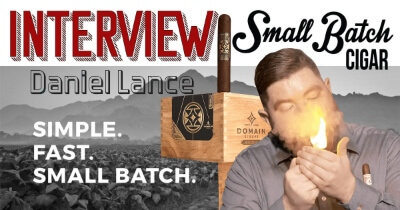
For those that don’t recognize your name, what can you tell us about your history in the cigar business prior to launching Domain?
I spent nearly a decade working with some of the most notorious cigar lounges in the United States in various capacities. I’m the cofounder of Lujo concepts, a cigar accessories company approaching its ninth year since we started production.
And I’m the junkie that moved to the Poppyfield. My interest in learning more about cigars is what brought me to Nicaragua five years ago, with no plan or intention of starting a cigar company.
How did you and Esteban Disla meet and when did you know he was the perfect fit for Domain?
Esteban chose me. I want to be clear about that. He had some incredible offers on the table. He’s been known in the 40 years of his career for making some of the most triumphant cigars. At one point, he was the master blender of nearly 30 brands. We became good friends, and I was close with his family as we lived about 10 minutes apart in Esteli for a long time.

Esteban Disla, Co-Founder of Domain Cigars. Photo Credit: Domain Cigars
The passion we share for tobacco set the terms of our negotiation to create a completely vertical, integrated cigar company from day one. When you connect the factory to agriculture and join those under a single house of cigars it enables you to set in motion projects that normally you could only dream of.
With all the different hats you’ve worn in the industry to date, can you explain just how hard it is for the average cigar enthusiast to create a dynamic, complex cigar?
Blending a delicious cigar is novel and has its own complexities. I always tell people if you go to a restaurant and you’re from out of town and you ask the chef for the recipe because you think you can make the dish yourself, and the chef says “yes, of course,” but when he hands you the recipe it says “cut of beef” and you ask the chef “what cut of beef” and the chef tells you “I don’t do the shopping. I just bring the ingredients together.”

Negentropy by Domain Cigars. Photo Credit: Domain Cigars
There are no chefs that don’t know how to go shopping. Knowing how to buy and select tobacco is an essential part of blending a cigar. To do that well and create a reliable blend that can be reproduced by hand thousands of times over is a challenge.
We think of blends as projects. Sometimes those projects span over half of a decade. Combining the ingredients at the end of a long project is writing the history of our performance with that tobacco.
I love the fact that Domain launched with a medium intensity expression of San Andres! Please describe the Despanic fermentation process used.
Neutron is a masterpiece, Negentropy shows our range of tobaccos with much different character. The Despanic Process is something the Disla family has been working on continuously for decades now. Sergio Cuevas taught Esteban the traditional farm style Pilón Sergio was familiar with from Cuba where the tobacco is often stacked with the entire lot or hectare in a single loaf-stack. The Dominican style is to separate the primings based on cultivation like Ligero, Viso, Seco. The Nicaragua process is similar, but they typically remove L3 or V3s from this and build them into a separate Pilón since L3 or V3s leaves are typically a little bit thinner.
The Despanic Process is designed by two master blenders Raul and Esteban Disla. They started building Pilóns based on the offset flavor profiles: Seco is in it’s own Pilón; Viso goes with L3 Ligero in the Pilón to inoculate the Viso with the flavor compounds of the Ligero. We refer to this as “doping” the Pilón, it’s a completely natural way of maintaining robust oils that might otherwise mellow out during the cycling of the Pilón.

Neutron by Domain Cigars. Photo Credit: Domain Cigars
It’s the kind of innovation you can expect from Esteban. Instead of just discarding what is considered lower grade, he uses nature to enhance the blend. Highly modified but observant of tradition.
What do you think attributed to Mexican San Andres tobacco usually being type-cast as a fuller-bodied blend?
It’s a good question and one that probably needs to be researched more. My initial assumption would be that it was the procurement process for cigar makers. It was a thick oily wrapper that took a lot of extra time and labor, however, nobody seemed to be asking for it. So, the handful of families that were farming this wrapper in Mexico likely did not have that many people to trade with.
I believe that might be why it showed up in a lot of catalog cigars for cheap. The cigars traditionally would be full body due to their use of Volado in the blend opposed to Seco. Medium San Andreas can have a chalky taste normally. The only way to overcome this is by balancing the saline content or salt of the other tobaccos. When you do that just right, the incredible flavors can really shine. Like salting a watermelon.
Domain Cigars launched with 18 sizes across two blends. How hard is it to debut with so many vitolas all at once?
The most difficult part is choosing which sizes don’t make the cut. Ultimately, there’s a lot of market pressure on size (no pun) that determines what you should make. And that’s who we listen to – the customer – since our preferences are in every cigar we put out.
The decision to ratio blend all of the sizes is another unique feature. This means the same ratio of each tobacco is in every size. Because the binder and the wrapper are proportional to the cigar this makes going through the line and trying each size a lot more fun.

Photo Credit: Domain Cigars
As for the production, it is challenging but the average experience in our factory is 20+ years. Even with that experience, we have a requirement of making about 200 of each size for a grand total of up to 3000 Cigars per blend. This helps the QA become familiar with the blend and resetting the team as we move through each size.
Esteban and I then go through and validate each size against our master blends (these are the cigars that we originally approved.) From here, we can start diagnosing issues that can come up during production and we make a catalog of instructions so that the team automatically knows how to respond to issues. The quality control system only gets more complex from here.
Speaking of the launch, Domain made a huge splash with an unconventional launch strategy. Would you mind breaking that down for our cigar enthusiasts that aren’t on the retail side?
I was speaking with a good friend of mine about the company and he asked me how I was planning on introducing it to everyone and immediately I thought like every other cigar company… Write a nice email, get some jazzy photos on Instagram, and let the cigar media write the message to everyone. But then I thought to myself, all the years working behind the counter as a retail tobacconist I never had a new cigar company make me feel special. I was a nerd about cigar companies, but in nearly a decade I had rarely been the “first to know” so I went back to my cyber security skills and thought, “how would I approach this as an attacker?” Tell all of the retailers, but still put together a marketing campaign. Distribution by proxy.
So, we spent a year writing down our story and analyzing hundreds of cigar stores: our goal was to find people we could grow with; people that had a unique way of looking at our community. That’s why Small Batch was chosen.
I flew all around to each of our suppliers and met with them personally even though some of these people Esteban has been working with for 20+ years. And I discussed the story that they wanted to hear which led to a documentary being made titled “Few Masters” and the slogan “from soil to smoke.”
We then took our design language and crafted a celebration box of our cigars 1/100. We used beautiful inlays and the same finishing from our production cigars with a QR code to make it a video box. We then sent that to 100 high priority retailers and asked them to join us in the celebration of the lunch of Domain Cigars. We weren’t mailing samples, asking people to buy our cigars, but we were asking them to be part of our story.
When crafting a new blend, what do each of you look for in the creation process?
It’s a great question. The most philosophical way of answering it would be that we’re looking for Cigars that have cultural significance. No, this is not always an edgy, new Maduro. Our San Andreas project was actually targeting a reset of San Andreas.
We have a set of shared goals right down to the box and we designed seven different lines of cigars. We created more than a dozen blends to land on N7b that was in the 1/100 box. And we are still working on selecting two tobaccos slightly different for that project.
And maybe that’s what is the most significant difference in how we think about producing cigars is we believe each one is a project. Sometimes that project comes together in an afternoon like lightning in a bottle.
We are working on another project right now that we don’t anticipate being remotely close to completion for another 2 1/2 years. Putting the tobacco together in a blend is an important part of what we do, but often we are planning for that day with years of preparation.
What are three things that most people don’t know about you and Esteban Disla?
We both came from extraordinarily modest upbringings that provided each of us with a lot of challenges and instilled a strong work ethic.
We both followed our love for tobacco to Nicaragua. Esteban could have went to Miami 25 years ago and cigars from Nicaragua might have forever changed. We always joke that he probably would’ve made more money if he had been a bartender on the beach in Miami 25 years ago. You’re not in this side of tobacco if you’re not passionate about it and maybe a little crazy. I moved to Nicaragua for an education about tobacco and was reminded of the simplicity of my upbringing on Esteban’s farm: we have cows, chickens, and goats. We like that we can be in proximity to the work. We both love being humbled by the humility around us.
We have similar palates regardless that I speak Spanish like a toddler. We are very similar in our description of flavor, we will even profile our employees’ flavor profiles, and we always pick exactly the same cigar that we know the person is going to like. I credit that to my time working as a tobacconist, but Esteban thinks about it as components of tobacco. I think of it as that blend of cigar they won’t like, but he looks at it as a viso-seco interaction they won’t like and this allows him to adjust the blend exactly to a preference. It’s that same skill of knowing your friend is really going to like a cigar, but actually knowing how to do something about that.
If there’s just one thing that our readers can take away from you or Domain Cigars, what would you like for them to know?
Esteban Disla's journey from agricultural laborer to owning a cigar brand is a testament to his lifelong dedication to tobacco. His commitment to quality and craftsmanship shines through in every Domain Cigar. An enterprise this large is rarely seen among new entries into this market. Every time you light up a Domain Cigar you are taking part in a narrative that has a lifetime of work and passion. We are the Third Wave cigar maker from Nicaragua, and we thank you for taking part in this incredible story!
What can your fans expect over the next 12-18 months?
Over the next year, fans can anticipate new projects and blends that continue to push the boundaries of cigar craftsmanship. We're excited to share our passion for tobacco with enthusiasts around the world through innovative and exceptional cigars.


Leave your comment